Our standards
How We Size, Quote and Install HVAC Systems in Bay County
Heating and cooling is a trade with a trust problem: most homeowners cannot verify a diagnosis or check a tonnage. So instead of asking you to take our word for it, this page sets out exactly what we do on every job, what you receive in writing, what we refuse to do, and the published standard behind each step, so you can hold us to it.
Updated October 2026. Applies to every residential installation, replacement and repair we quote in Panama City, Panama City Beach, Lynn Haven and the rest of Bay County.
The standard, in one list
Each item names the standard we hold ourselves to and links to the page that explains it.
- Written quote before any work begins. You approve the price before we pick up a tool, on a repair or an installation.
- A load calculation on every installation quote, from your house as it is today, explained to you. Standard: ACCA Manual J, the basis Florida's energy code requires for new systems.
- Equipment selected from performance data, not the label, within the code's 100 to 115% window. Standard: ACCA Manual S and Florida Building Code R403.7.1.1. The calculator shows why the label figure is not enough.
- A ductwork assessment with every installation quote, because a new unit on leaky ducts never delivers what it says on the label.
- Coastal-rated equipment specified on every installation, with the level of protection and what it costs set out on the quote. Why: salt air and your AC.
- Repair first when repair is the honest answer. Nobody on our vans works to a commission target.
- Permits pulled, warranty registered, follow-up made. On every installation.
1. Before the quote: measure, don't guess
Every installation quote starts with a load calculation. That means measuring the house: window sizes and orientation, insulation levels, ceiling heights, where the ducts run and what condition they are in. It does not mean dividing the square footage by 500. The Department of Energy says rules of thumb "are too often used to size comfort systems, which results in excessively oversized systems," and UF/IFAS tells Florida homeowners not to use "a contractor who wants to size your system solely on the square footage of your house." We agree, and we have put a calculator on this site that shows what the square-footage rule gives and why it runs high, so you can see the difference for yourself.
For Panama City the design conditions we use are the ones NOAA's engineering weather data (1988 to 2017) gives for Tyndall AFB: a 1% cooling design of 90°F dry bulb with a 79°F coincident wet bulb, and an indoor condition of 75°F as Florida's code sets it. Not 95°F "to be safe." Florida's code does not allow a safety factor, and in a humid climate the safety factor is what makes the house clammy.
What you receive: the result of the load calculation, with the sensible and latent loads explained separately, and a plain-language walk through what drove it.
2. Selecting the equipment
The load tells us what the house needs. The selection step matches a specific outdoor unit, indoor coil and air handler to it using the manufacturer's expanded performance data at those design conditions, not the nominal tonnage on the label, which Florida's code says "shall not be used for equipment sizing." The chosen unit's total capacity lands between the calculated load and 1.15 times it, and we look at its latent capacity against the latent load, because in Bay County moisture removal is a large share of the work.
We quote more than one option where it makes sense: efficiency levels, single-stage against variable-speed, and what each means for running cost and humidity control. The efficiency floor is set by federal law for the Southeast region (14.3 SEER2 for split-system air conditioners under 45,000 BTU/h); we will tell you where the sweet spot sits for your house and budget rather than pushing the top of the range. For a heat pump, selection also covers the heating side: the winter balance point and backup heat strip sizing, set out on our heat pump installation page.
What you receive: the proposed equipment's sensible and total capacity at design conditions, and the AHRI reference for the matched combination, on request.
3. Coastal specification as standard
Marine air is the single biggest threat to cooling equipment in Panama City, and standard warranties from the major manufacturers exclude corrosion damage. So on every installation we specify equipment built for this environment: welded aluminum or coated coils, protected cabinets, sealed brazed joints and stainless or marine-grade fasteners. What "coastal-rated" means in each manufacturer's literature, and what their warranties do and do not cover, is set out in salt air and your AC.
What you receive: the make and model of every component on the quote, so you can check the coastal specification against the manufacturer's own published details.
4. The ducts
A ductwork assessment is part of every installation quote. Florida attic ducts run through a space that reaches about 120°F on a summer afternoon, and the Florida Solar Energy Center's field work found that duct repair alone cut cooling energy use by 18% in the homes it studied. Sealing accessible leaks and correcting obvious restrictions is often the cheapest performance upgrade available, and sometimes it is the whole answer: a comfort problem that looks like an undersized unit is frequently a duct problem. Florida's energy code requires R-8 insulation on attic ducts; we tell you what yours have.
What you receive: the duct findings with the quote, including anything we recommend fixing before or alongside the installation.
5. The quote itself
Equipment options, efficiency levels and prices laid out clearly, in writing, before any work starts, with financing options available if you want them. If a cheaper fix will do the job, that is the one we recommend. If a system is on borrowed time, we show you why rather than asking you to take it on faith. The quote is yours to compare; we would rather lose a job to a competitor who sized the house properly than win one by skipping the step.
6. Installation and commissioning
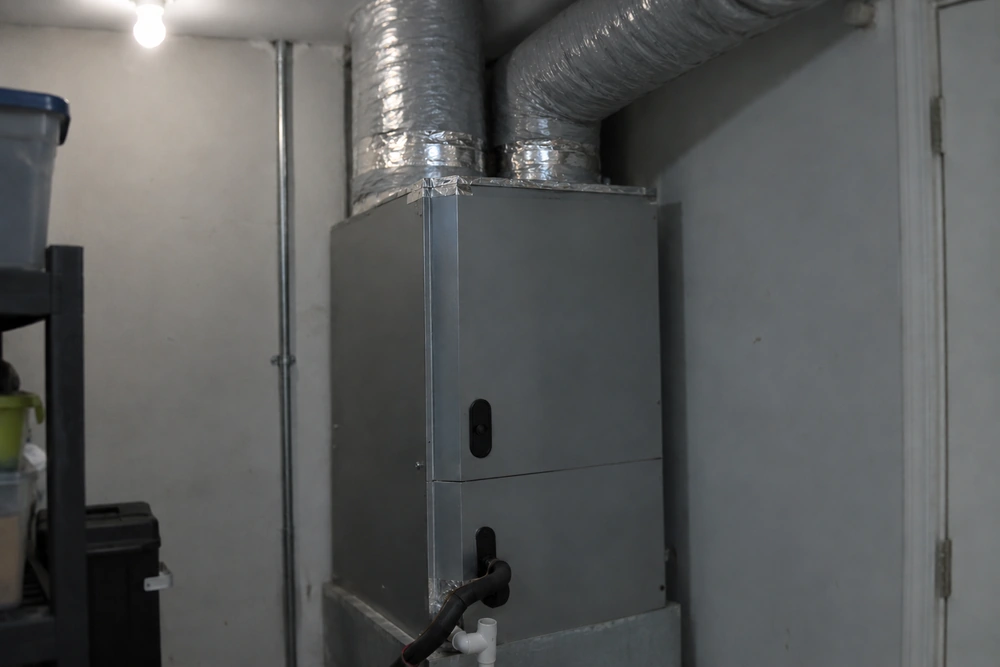
Permits are pulled and the paperwork handled. The old unit is removed and disposed of. The new equipment is fitted with the hardware the coastal specification calls for, the refrigerant charge is set and verified, airflow is balanced and the thermostat is set up properly, including smart thermostats where they suit the house. Then a full commissioning check and a plain-language walkthrough of the system before we leave. Heat pumps are commissioned in both heating and cooling mode, whatever the weather on install day. The service detail for each system type is on AC installation and replacement and heat pump installation and replacement.
What you receive: the manufacturer warranty registered and explained, so you know what is covered and by whom, and our own workmanship follow-up.
7. After the job
We check in after installation to confirm the system is performing as quoted. On AC and heat pump repairs the same applies: the diagnosis is explained in plain language, the quote is in writing before work starts, and the follow-up call happens whether the job was a capacitor or a full system.
What we will not do
- Size a system from square footage alone, or put a firm price on a tonnage before the house has been measured.
- Copy the size of the old unit. An FSEC study of 368 new Florida homes found more than half had capacity above 120% of their Manual J load; the old unit is not evidence of the right size.
- Add a safety factor or a "Florida factor." Florida's energy code prohibits them, its 115% cap limits how far any round-up can go, and humidity control punishes both.
- Quote a lower level of coastal protection without telling you, in writing, what that means for corrosion and warranty.
- Sell you a system when a repair is the right call. Or the reverse: if replacement is the honest answer, we show you the arithmetic.
- Start work without a price you have approved.
How to check us
Three ways, none of which need our help:
- Licensing. HVAC contractors in this area are regulated by the Florida Department of Business and Professional Regulation, and Bay County operates its own contractor licensing program. Both can be checked online before any work is agreed.
- Permits. We pull a permit on every installation. The building department holds the record, and you can ask what was filed with it.
- The paperwork. Everything above that says "what you receive" is information you can take to another contractor, an energy rater or a building inspector. If it is missing, ask us for it.
Questions
Our process: common questions
Do you charge for the load calculation?
We do not charge for the load calculation: it is part of every free installation estimate, because we cannot quote a system honestly without it, and we walk you through the result.
What if I just want the same size as the unit I have now?
If you want the same size as your current unit, we will still run the load calculation and show you the result first. If it matches the existing unit, good. If it does not, you will see by how much and why, and the decision is yours with the numbers in front of you. In the Florida Solar Energy Center's study of new homes, more were oversized than right, so do not assume the existing unit was.
Can I get a quote over the phone?
You can get likely price ranges over the phone, but not a firm quote. For a repair, we can give you a realistic arrival window and explain how diagnosis works, with the price in writing once the fault is known. For an installation we can talk through options on the phone, but a firm price on a tonnage comes after the house has been measured; quoted without that, it is a guess.
Do you work on all brands?
We work on all major brands, servicing every make and model of heating and cooling equipment, from central air systems and heat pumps to ductless mini-splits. For new installations we specify equipment with a coastal option from the manufacturer's own range.
Standards and sources we work to
Researched against the sources below and last reviewed October 14, 2026. Figures are quoted with their dates; where the evidence is dated or thin, the text says so.
- Air Conditioning Contractors of America, Manual J: Residential Load Calculation and Manual S: Residential Equipment Selection
- Florida Building Code, Energy Conservation, sections R403.7.1 and R403.7.1.1, as reproduced in filed compliance reports under the 7th Edition and confirmed unchanged in the 8th Edition (2023) by the 9th Edition change analysis
- US Department of Energy, Proper sizing of HVAC systems; 2023 central air conditioner and heat pump standards FAQ
- University of Florida IFAS Extension, Energy efficient homes: air conditioning
- Florida Solar Energy Center, James et al., FSEC-PF-328-97 (oversizing in 368 new Florida homes, 1997); Cummings et al., FSEC-PF-217-96 (duct leakage in Florida homes)
- NOAA National Centers for Environmental Information, Engineering weather data: Tyndall AFB
- Florida Department of Business and Professional Regulation, license verification
Hold us to it
Free estimates, written quotes before work begins, and a load calculation on every installation across Bay County. If any step on this page is missing from a quote you receive from us, ask for it.